Note
Go to the end to download the full example code.
Heat diffusion.
Solve the heat equation by filtering the initial conditions with the heat
kernel pygsp2.filters.Heat.
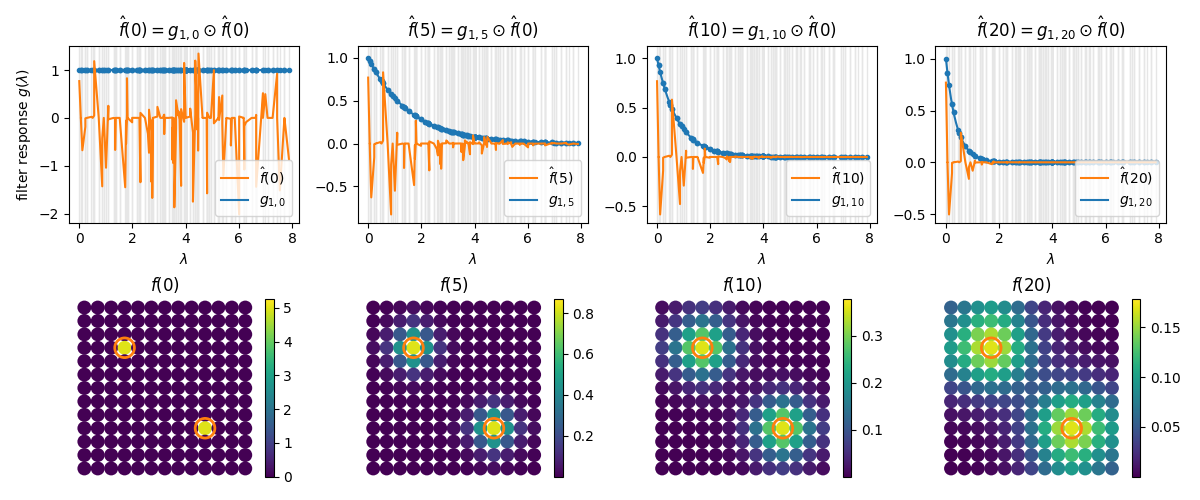
from os import path

import numpy as np
from matplotlib import pyplot as plt

import pygsp2 as pg

n_side = 13
G = pg.graphs.Grid2d(n_side)
G.compute_fourier_basis()

sources = [
    (n_side // 4 * n_side) + (n_side // 4),
    (n_side * 3 // 4 * n_side) + (n_side * 3 // 4),
]
x = np.zeros(G.n_vertices)
x[sources] = 5

times = [0, 5, 10, 20]

fig, axes = plt.subplots(2, len(times), figsize=(12, 5))
for i, t in enumerate(times):
    g = pg.filters.Heat(G, scale=t)
    title = r'$\hat{{f}}({0}) = g_{{1,{0}}} \odot \hat{{f}}(0)$'.format(t)
    g.plot(alpha=1, ax=axes[0, i], title=title)
    axes[0, i].set_xlabel(r'$\lambda$')
    #    axes[0, i].set_ylabel(r'$g(\lambda)$')
    if i > 0:
        axes[0, i].set_ylabel('')
    y = g.filter(x)
    line, = axes[0, i].plot(G.e, G.gft(y))
    labels = [r'$\hat{{f}}({})$'.format(t), r'$g_{{1,{}}}$'.format(t)]
    axes[0, i].legend([line, axes[0, i].lines[-3]], labels, loc='lower right')
    G.plot(y, edges=False, highlight=sources, ax=axes[1, i], title=r'$f({})$'.format(t))
    axes[1, i].set_aspect('equal', 'box')
    axes[1, i].set_axis_off()

fig.tight_layout()
plt.show()
Total running time of the script: (0 minutes 0.553 seconds)
Estimated memory usage: 177 MB